
Phillips County Parole vs Probation
Parole and probation are not the same status. In Phillips County, probation usually begins with a court order from Phillips Combined Court or another court in the 13th Judicial District. It can follow a guilty plea, sentencing, deferred judgment, revocation, or other court action. Parole begins after a Colorado prison sentence and is managed through CDOC and the Colorado State Board of Parole. A person released from the Phillips County jail function might be on bond, on probation, transferred to DOC, or later released to parole after a prison term.
| Status | Who orders or manages it | Best verification path |
|---|---|---|
| Probation | Phillips Combined Court and 13th Judicial District Probation | Court docket, probation order, and probation office contact. |
| Parole | CDOC and Colorado State Board of Parole | CDOC offender search, parole-board calendar, and CDOC confirmation. |
| Bond release | Phillips Combined Court and sheriff records | Court docket plus sheriff release record. |
| Discharge | The agency that supervised the sentence | CDOC, probation, or court record, depending on the sentence. |
- Parole
- Supervision after a state prison sentence, with release and discharge dates often tied to CDOC records.
- Probation
- Court-ordered supervision served in the community under local probation authority.
- Absconder
- A supervised person who has stopped reporting or cannot be located by the supervising authority.
- Revocation
- A court or parole-board process that can return a person to custody after a violation.
Verify Phillips County Supervision
The first verification step is to identify the sentence type. A local probation sentence should leave a court trail. A prison release should leave a CDOC trail. If the person has just left the Phillips County jail, the sheriff release record may show whether the release was to probation, another agency, bond, or time served. A single VINE alert or docket line should be checked against the agency that owns the status.
- Search the Colorado Judicial Branch docket for Phillips County case events.
- Look for sentencing, probation, revocation, warrant, bond, or dismissal entries.
- Contact the Phillips County Probation Office for procedural supervision questions when the docket shows probation.
- Use CDOC offender search when the person was sentenced to state prison or released on parole.
- Check the Colorado State Board of Parole calendar for public hearing schedule context, not as a guaranteed release record.
For the full release-record trail, use the Phillips County released inmates hub, because sheriff records and court records often need to be read together.
Phillips County Probation Office
The Phillips County Probation Office is part of the 13th Judicial District Probation Department. The Judicial Branch page says the district serves seven counties and has full-time staff in Morgan, Logan, Yuma, Washington, and Kit Carson Counties, with part-time satellite offices in Phillips and Sedgwick Counties. That structure matters because post-release reporting may be handled through a regional probation office rather than a large Phillips-only office.
Phillips County Probation Office
221 S. Interocean Ave.
Holyoke, CO 80734
Chief Probation Officer: Eric Ross
Phone: 970-526-3999
Email: eric.ross@judicial.state.co.us
The probation page states that probation provides pre- and post-sentence assessment, evaluation, supervision, and monitoring for misdemeanor and felony offenders ordered by the court to participate. The public record path remains the court docket and court file. The probation office can handle procedure questions within lawful limits, but private supervision details may not be available to every caller.
Phillips County Probation is the local source for the office details above.
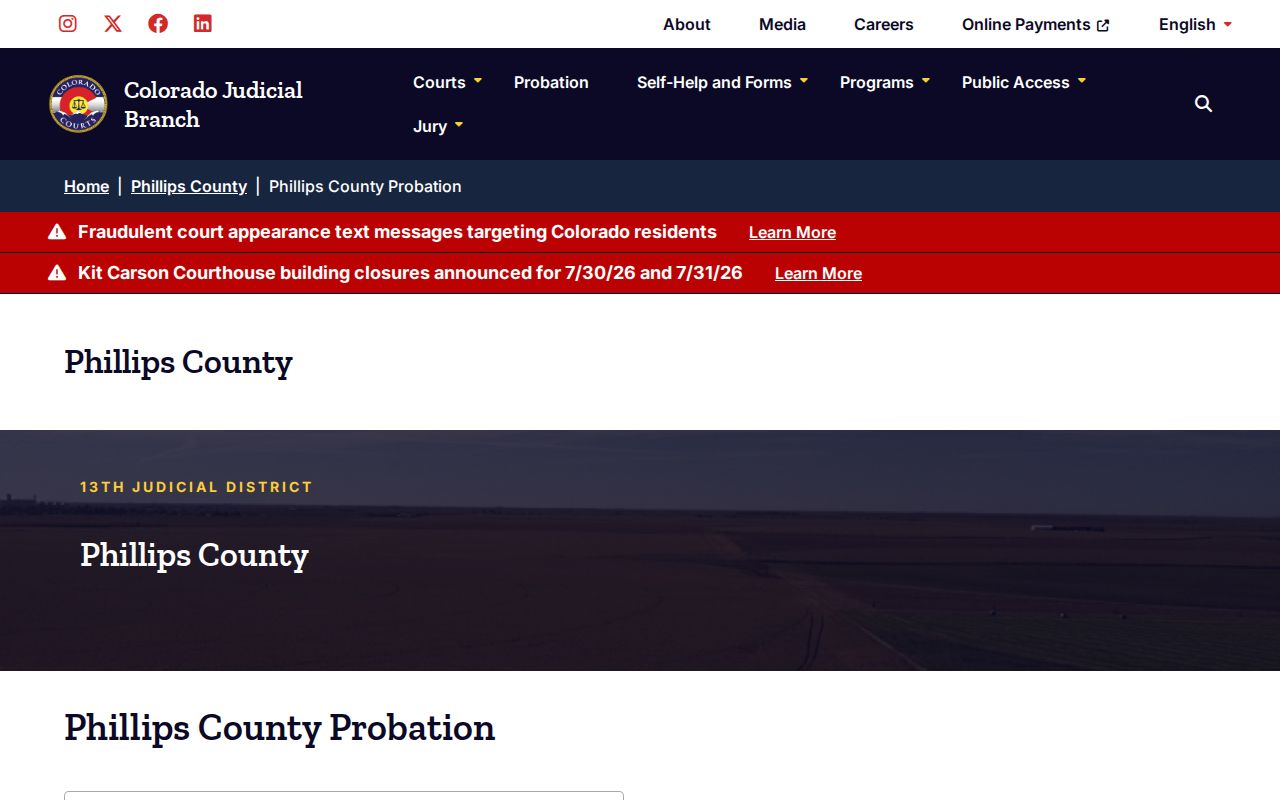
The screenshot fits this page because it shows the local probation source rather than a generic supervision office.
Phillips County Parole Hearings
Phillips County does not have a separate county parole board. A person convicted in Phillips County and sentenced to state prison enters the statewide CDOC and parole system. The State Board of Parole calendar inside CDOC offender search shows monthly hearing calendars. The page says future months become available after scheduling is set, hearings are subject to change, and modifications made by DOC are available the following business day.
The calendar is useful when a release date changes because a parole hearing can affect the practical timeline. A hearing does not mean physical release that day. Release can depend on the board decision, parole plan, detainers, transportation, conditions, or rescission before departure. For application or rescission hearings, the official page points to the offender's case manager for attendance arrangements. For revocation hearings, it points to the jail where the offender is located.
Phillips County Absconder Checks
No official Phillips County sheriff absconder list was verified in the researched local pages. That means a page should not imply that Phillips County publishes a stand-alone local absconder feed. If a probationer stops reporting, the court file, warrant status, and probation contact are the better official paths. If a parolee absconds, CDOC and parole authorities are the state-level sources.
Colorado VINE may help with custody-change notices for county jail cases when the relevant jail feed is online, but it is not a complete supervision database. Phillips County's own COVINE page warns that CDOC is not in COVINE. A parole return to custody, revocation hearing, or prison-release status should be checked through CDOC and the court record that caused the custody change.
Do not treat a missing local absconder list as proof that no warrant or violation exists; use the court and supervising agency.
Phillips County Release to Probation
Angle R from the research is important here: Phillips County probation operates within a seven-county judicial district with part-time satellite staffing in Phillips and Sedgwick Counties. A released person may have reporting terms that refer to a district office, a satellite schedule, or instructions in the court order. The release from jail is only one part of the record. The probation order explains what happens next.
For a person released from the Phillips County jail function to probation, request the sheriff release record if the exact custody event is needed, then read the court docket or case file for sentencing terms. Use the probation office for lawful procedure questions about reporting. This path is different from parole, where CDOC offender search and State Board of Parole materials are the key systems.
Phillips County Supervision Discharge
Supervision ends through the system that imposed it. Probation can end through court discharge, successful completion, modification, revocation, or another court order. Parole can end through CDOC discharge, revocation, mandatory release timing, or completion of state supervision. Colorado sealing rules may later limit public visibility of older court records, especially when the case is dismissed, deferred judgment is completed, or a sealing order applies.
CDOC's public disclaimer says database information can sometimes be inaccurate and should be confirmed with CDOC. That caution applies to release and discharge dates. Court and probation records can also change after hearings. Use the newest official source for the status being checked, and do not combine probation and parole into one category when the record says otherwise. Note: probation is a court status, while parole is a state-prison release status.
Phillips County Court Orders
Probation verification often starts with the Phillips Combined Court file because probation is imposed by the court. The docket or requested case record may show a sentencing order, deferred judgment, revocation order, modification, warrant recall, or discharge entry. It may also show whether the person was released from jail to report to probation, stayed in custody on another hold, or was sent to DOC under a mittimus.
For parole, the court record is less likely to show the day-to-day supervision status after a prison release. CDOC and the State Board of Parole own that path. Still, the original Phillips County judgment can explain why the person entered DOC and why parole later became relevant. Reading the court order, CDOC record, and parole calendar together gives a cleaner answer than treating any one source as complete.
| Record | Supervision clue |
|---|---|
| Sentencing order | Shows probation, jail, prison, or other sentence terms. |
| Revocation entry | May explain return to custody or changed supervision. |
| Discharge order | Can show the end of probation in the court file. |
| CDOC offender record | Can show parole, release, or discharge dates as applicable. |
VINE Supervision Limits
Colorado VINE is useful for custody alerts, not for a complete probation or parole file. Phillips County's COVINE page says COVINE covers Colorado county jails that are online with the system and that CDOC is not in COVINE. A release notification may tell a registered user that custody changed, but it will not replace a court probation order, a CDOC parole record, or a parole-board schedule.
Use VINE to watch for a custody change when the person is in a covered county jail feed. Use the probation office when the court has ordered local supervision. Use CDOC for state parole. That split keeps a Phillips County jail release from being confused with a state-prison parole status, and it prevents a notification result from being read as the full supervision file.
Public Record Search
Sponsored Results